
The History of Ruby Marie
Madison’s history of hospitality began with its first settlers. Eben and Roseline Peck were the initial family to build on the swampy land that James Doty set aside to replace Belmont as the capital of Wisconsin. The Pecks’ two connected cabins, built in 1837, not only served as their home, but also as a public house for newcomers in the undeveloped area. The cabins became a place where new arrivals could find food, shelter, and comraderie under one roof. This premier establishment is memorialized in its original location and can be found only a few short blocks from the Hotel Ruby Marie.
This single log structure blossomed into the capital city we know today.
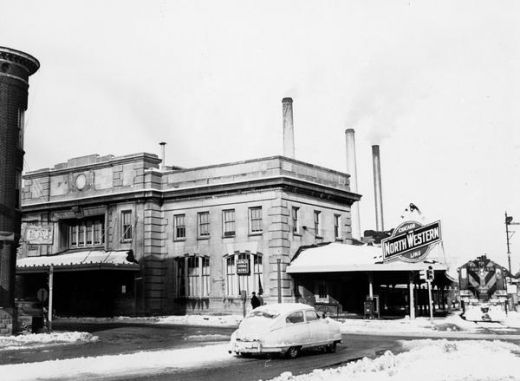
The railway was first introduced to the Madison area in 1854 with a depot six blocks west of the capitol building. In 1869, the East Madison depot opened on the115 block of Wilson St., but it was to be the third competing depot built on the corner of Blair and Wilson streets that was to be the inspiration for a hotel to be built on opposite side of Blair St. In 1873, two years after this third depot was added to Madison, a wooden structure was erected and opened its doors to the influx of people to the area. The initial proprietor was a man by the name of August Ramthun, but Ramthun Saloon and Rooms would soon give way to title of East Madison House. Within ten years, it would come under new ownership and undergo a transformation.
John B. Drives took over the proprietorship and encased the wooden structure with brick. He also met the expanding need for rooms by adding an addition to the rear of the building creating a center area for a courtyard. Between its opening in 1873 and today, the building would change names five times and go through a total of 14 propriators. Charles Elver, a member of one of Madison’s early prominent families, created the Elver House which would remain its name until 1939. From 1940 until 1946, it was the Lake View Hotel before becoming the Wilson Hotel.
During this period, not only the hotel, but the block went through an evolution. With such an influx of people from many walks of life, this area of depots, hotels, and saloons became a wasp’s nest of trouble. Nightly rates went down and a seedy aspect of culture sprang up. Bar brawls, prostitution, and heavy intoxication marked a very rough era. It was these “dark ages” of Wilson street that would give way to an entrepeneur looking to made a difference.
In 1982, Robert Worm was stopped in traffic at the lights on the corner of Wilson and Blair Streets. Viewing the 115 block of Wilson, an idea began to formulate. Bob would first open the German themed Essen Haus in what was once the Germania Hotel located one door down from the Wilson Hotel. This successful revamping of the old buildings spread across the block. He would soon open the Come Back In to one side and followed that up with one of the greatest undertakings of his career; bringing a new life to a hotel that had become a dark and dingy place of ill reputation.
The renovation in 2000 capped off a tumultuous century and escorted the hotel into a new era. Robert Worm renamed the hotel after his mother, and the Ruby Marie would outshine any of its previous guises. It was re-introduced to its Victorian roots, but with an elegance the original builders would never have pictured. There is a flair from its vintage days that has succeeded in creating a historical essence without smothering its guests in floral and lace. The original 36 doors are all still intact to remind us of her more crowded days, but many of them were closed off as the rooms they concealed opened up into the more spacious fifteen guest accommodations. Each unit was given its own plumbing, and the days of the shared bathrooms came to an end.

